The Numbers Look Convincing Until the Campaign Ends
The pitch usually sounds straightforward. A creator with a sizeable following, strong engagement numbers, and content that looks aligned with the brand. The brief gets written, the content goes live, and the metrics come in looking reasonable. Impressions, views, reach. Then someone asks what actually changed for the business, and the answer is harder to give.
This is not an unusual outcome. It is, in fact, one of the more common ones. Campaigns that perform well by platform metrics and produce little measurable commercial impact tend to share a specific origin: the influencer was selected for what their numbers suggested rather than what their audience actually was. The content reached people. It just did not reach the right people at the right moment, and no level of production quality was going to close that gap.
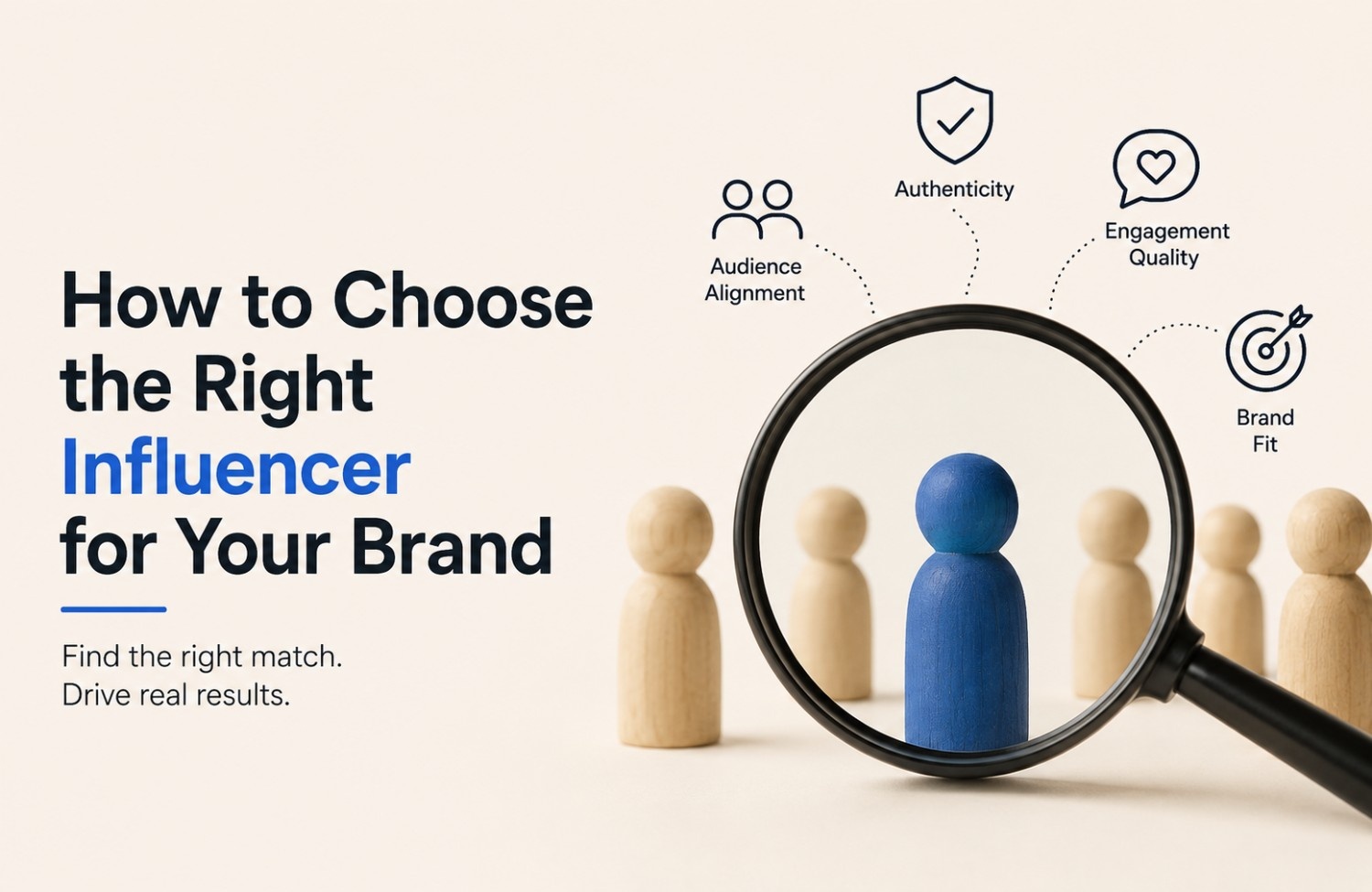
Choosing the right influencer is less like filling a brief and more like making a judgment call with incomplete information. The selection criteria that appear most reliable on the surface, follower count, engagement rate, niche category, tend to be the ones most likely to mislead when used without deeper evaluation. What sits beneath those numbers is where the real selection happens.
Follower Count Is the Least Reliable Signal
A large following tells you that a creator built an audience at some point, under some conditions, around some kind of content. It does not tell you whether that audience is still paying attention, whether it was ever the kind of audience that acts on recommendations, or whether the content that built the following has anything to do with what the brand is trying to say.
Follower counts can be purchased, inherited from a viral moment years before a creator’s content shifted direction, or composed primarily of passive accounts that followed once and never engaged again. None of that is visible in the headline number. And even a completely legitimate following of a million people is commercially useless to a brand if the overlap between that audience and the brand’s potential customers is negligible.
Engagement rate is the correction most brands reach for next, and it is more useful, but only up to a point. Engagement can be incentivized through giveaways, inflated through comment pods, or concentrated around a specific content type that has nothing to do with the brand’s category. A food creator with intense audience engagement around recipe content may see that engagement drop sharply when a sponsored post appears for a software product. The audience did not leave. They just were not there for that.
The more precise question is not how engaged is this creator’s audience in general. It is how does this audience behave when this creator steps outside their core territory, and what does the history of their sponsored content tell us about that.
Audience Alignment Goes Deeper Than Demographics
Most influencer briefs include an audience demographic target. Age range, gender split, location, maybe household income. These are reasonable starting points and genuinely not enough on their own. Demographics describe who someone is in the broadest possible sense. They say almost nothing about what that person believes, what they are trying to solve, or how they make decisions in the category that matters to the brand.
The more useful question is behavioral. Does this creator’s audience act on recommendations in this domain? Have they demonstrated, through their comments, their questions, their purchasing patterns where those are visible, that they trust this creator’s judgment on things adjacent to what the brand is offering? Trust is not evenly distributed across a creator’s content. An audience that trusts someone’s opinion on travel gear may be entirely unmoved by their opinion on financial products, even if the demographic profile looks identical.
Values alignment between creator and brand is another layer that is easy to underestimate until it becomes visible in the wrong way. Audiences notice when a sponsorship feels out of character for someone they have followed for a long time. Not because they object to creators being paid, but because a misaligned partnership signals something about how the creator views their own audience. A single out-of-character collaboration can create a friction that takes several subsequent posts to dissipate. That friction costs the brand as much as it costs the creator.
Niche specificity often outperforms broad reach for exactly this reason. A creator whose entire presence is built around one narrow domain tends to have cultivated an audience that arrived precisely because of that specificity. The trust is concentrated rather than distributed. For brands whose product requires genuine consideration before purchase, that concentrated trust is often worth more than the raw numbers of a generalist creator with a larger but shallower audience relationship.
The Signals That Are Harder to Fake
Most of what makes an influencer genuinely right for a brand sits below the level of analytics dashboards. It requires reading the content itself, looking at the comment sections as a qualitative document, and paying attention to patterns that only become visible over time.
Comment quality is one of the most reliable of these signals. Genuine community engagement has a texture to it. People ask follow-up questions. They reference earlier content. They disagree with each other, or with the creator, in ways that suggest they are actually thinking rather than performing engagement. The alternative, short affirmations, emoji clusters, repetitive phrases that read like they were generated rather than written, is a sign that whatever number appears next to the engagement rate, the community beneath it is not particularly real.
Consistency of content positioning over time is another. A creator who has spent three years building a clear, coherent identity around a specific set of values or a specific way of seeing things is a fundamentally different partner than one who has been visibly shifting with whatever content format or brand category was willing to pay. The first has built something durable. The second has an audience that is accustomed to inconsistency, which means they are less likely to be influenced by any individual piece of content, sponsored or otherwise.
How a creator handles sponsored content specifically is worth examining in detail before any outreach begins. Integrations that feel natural, that emerge from the creator’s own language and framing rather than from a brand brief written by someone who has never watched their content, perform differently than ones that read like a script dropped into the wrong show. The audience knows the difference. They always know the difference. What varies is whether they care enough to say so.
Past brand partnerships are also a record worth reading carefully. Not to find red flags in the categories themselves, but to understand what kind of editorial relationship the creator tends to have with the brands they work with. Do they bring their own perspective to the sponsorship, or do they defer entirely to the brief? The former is harder to manage and almost always more effective.
Reach Versus Relevance Is Not a Close Call
For most campaigns with specific commercial objectives, relevance wins. Not because reach does not matter, but because reach without relevance is an expensive way to generate awareness among people who were never particularly close to acting.
A creator with eight thousand followers in a tightly defined professional or interest community will often deliver more measurable impact for a niche product or service than a creator with eight hundred thousand followers whose audience shares only a loose demographic resemblance to the brand’s customer. The smaller creator’s audience arrived because of a specific draw. They stayed because that draw continued. They trust the creator’s judgment in that specific domain in a way that is genuinely difficult to replicate at scale.
Reach matters when the goal is genuinely about exposure: building name recognition in a category where the brand is unknown, reaching an audience that is broadly right even if not precisely targeted, or creating content that will be amplified through paid distribution anyway. In those cases, a larger creator with a looser audience relationship may be the more efficient choice.
But when the objective is conversion, trust transfer, or reaching a specific kind of buyer who is already somewhere in their decision process, the calculus shifts toward relevance almost every time. The specific question of how creator scale affects campaign outcomes across different brand goals is worth thinking through carefully before committing to a tier. Micro vs macro influencer decisions involve trade-offs that go beyond audience size, and those trade-offs look different depending on what the campaign is actually trying to accomplish.
What a Good Partnership Looks Like Before the Brief Is Written
The strongest influencer partnerships tend to share a quality that is difficult to manufacture through contracting: the creator already understands, or is genuinely curious about, what the brand does and why it matters to a specific kind of person.
This is not about requiring that every creator be a pre-existing customer. It is about noticing whether there is a natural proximity between what the creator cares about and what the brand is offering. When that proximity exists, the content that comes out of the partnership has a quality that audiences respond to differently. It does not read like a placement. It reads like something the creator would have said anyway, with the brand appearing as a natural part of that context rather than an interruption of it.
The early conversations before a partnership is formalized reveal more about fit than any media kit. A creator who asks specific questions about the product, about the audience the brand is trying to reach, about what the brand believes differentiates it, is demonstrating a kind of engagement that tends to translate into better content. A creator who asks primarily about deliverables, approval timelines, and exclusivity windows is telling you something different about how they approach the work.
Long-term partnerships consistently outperform one-off campaigns by nearly every measurable standard. The first collaboration is usually the least effective, because the audience is still forming a pattern of association between the creator and the brand. By the third or fourth appearance, something has settled. The brand has become part of the creator’s world in a way that the audience has absorbed rather than noticed. That accumulation is what produces the kind of trust transfer that actually changes commercial behavior.
The Right Influencer Is Specific, Not Optimal
There is no universally right influencer for any brand. The search for the best option, the one with the strongest numbers, the cleanest brand safety record, the highest engagement rate in the category, tends to produce partnerships that look correct on paper and feel slightly off in practice. Optimization against visible metrics selects for impressiveness, not fit.
What actually predicts a productive partnership is specificity of alignment: between the creator’s audience and the brand’s real customer, between the creator’s content register and the brand’s genuine voice, between what the campaign needs to accomplish and what that particular creator’s relationship with their audience makes possible. Those alignments are not findable through a platform search filtered by follower count and category tag.
The campaigns that produce something real tend to start from a different question. Not which influencer has the strongest profile in our space, but which creator’s audience is already thinking about the problem our product solves, and which creator has built enough trust in that specific domain that their recommendation would carry actual weight with that specific audience.
Getting that level of precision into an influencer strategy is harder than it sounds and considerably more valuable than the alternative. Influencer marketing services built around genuine audience alignment and strategic partnership development produce outcomes that campaigns built around surface metrics rarely do, because they start from a clearer understanding of what the right match actually looks like before the first message is sent.