Google Ads vs Facebook Ads: Which One is Right for Your Business?
Google Ads captures demand that already exists. Facebook Ads creates demand that doesn't exist yet. Picking the wrong one is the most expensive mistake in paid advertising — here's how to get it right.
What You'll Learn
- The Allocation Decision Most Businesses Get Wrong
- The Fundamental Difference Is How People Arrive
- What Google Ads Does That Facebook Cannot
- What Facebook Ads Does That Google Cannot
- The Conditions That Determine Which Platform Fits
- Running Both Platforms — What That Actually Requires
- The Right Platform Follows From the Right Question
- CAC, CAC Payback, CLTV & Churn — Explained in PKR
- Free Paid Ads ROI Calculator (PKR)
- Free 4-Step Starter Strategy — Karachi, Lahore, Islamabad
- Frequently Asked Questions
1. The Allocation Decision Most Businesses Get Wrong
A business decides to run paid ads. Someone suggests Google because that's where buyers are searching. Someone else suggests Facebook because the targeting is more precise. A budget gets set and the campaign launches before anyone answers the question that should come first: what does the person seeing this ad need to be thinking and feeling for it to work?
Six weeks later, the spend is gone, the leads are fewer than expected, and the creative or landing page gets blamed. The platform itself rarely gets examined — by that point, the budget has already shaped a commitment to it.
2. The Fundamental Difference Is How People Arrive
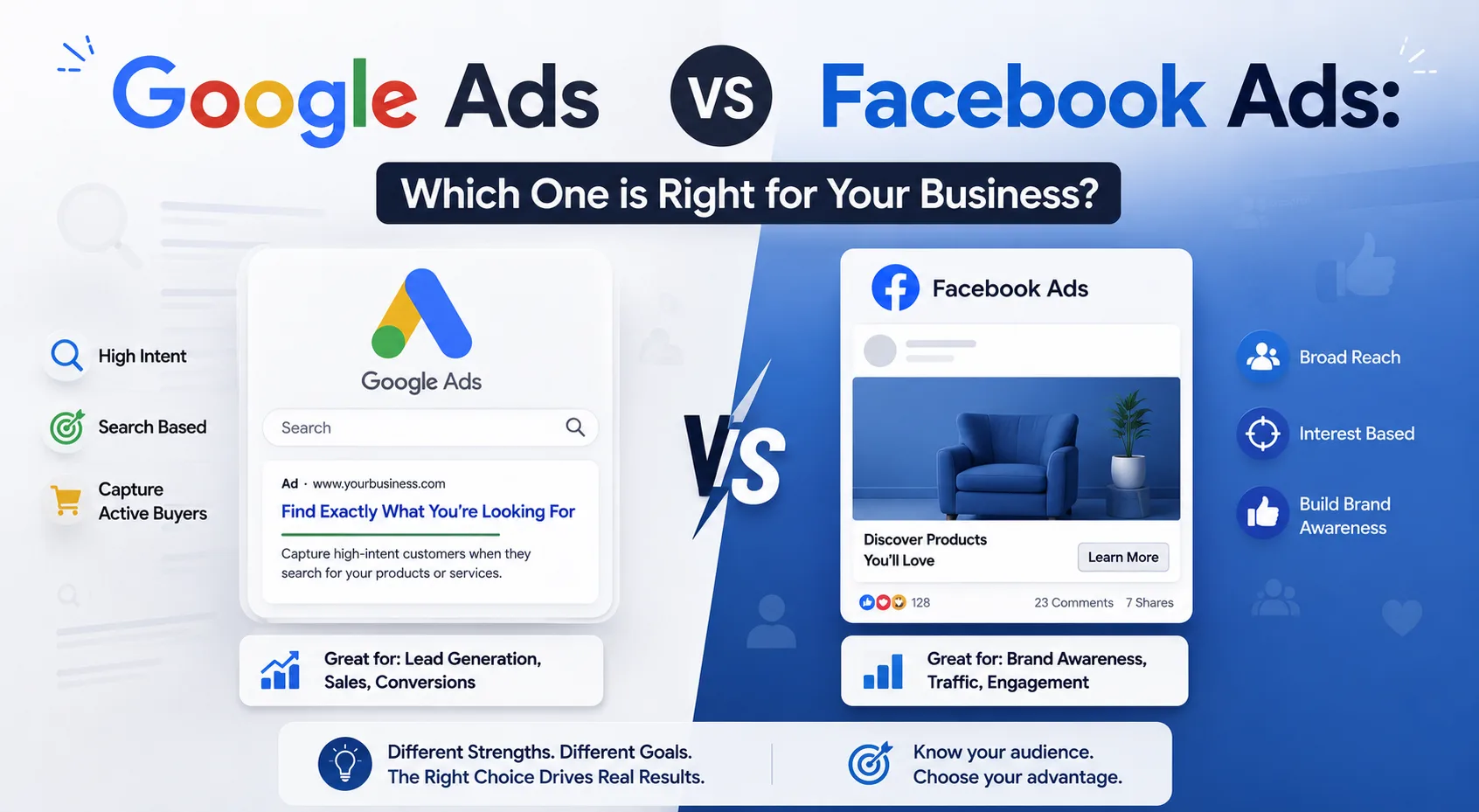
When someone types "digital marketing agency Karachi" into Google, the search itself is the signal. They already decided they need something. The ad doesn't need to create the want — the want was already there.
Facebook works in the opposite direction. A person scrolling their feed wasn't looking for anything in particular. If an ad succeeds there, it's not because it answered a question — it's because it created one.
| Signal | Google Ads | Facebook Ads |
|---|---|---|
| Buyer intent | Already exists (search query) | Not yet formed |
| Targeting basis | What people type | Who people are |
| Ad job | Capture existing demand | Create new demand |
| Conversion path | Shorter — buyer is already deciding | Longer — buyer needs persuading first |
3. What Google Ads Does That Facebook Cannot
A plumber running Google Ads isn't trying to convince anyone they have a leaking pipe — they already know. The search query is a brief: it tells the advertiser exactly what the person wants, at what specificity, and often how urgently. A query like "emergency IT support Karachi" carries commercial information no demographic profile can replicate.
The conversion path is shorter too — a Google click has already skipped the awareness stage. But the platform has a real limitation:
For businesses whose customers are actively searching, well-structured Google Ads campaign management determines how much of that existing demand converts rather than going to a competitor.
4. What Facebook Ads Does That Google Cannot
A skincare brand launching a new product can't wait for buyers to search for it — the search behavior doesn't exist yet. Facebook targets who people are: age, location, purchasing behavior, and interests, not just what they type.
The creative canvas is also different. A search ad has a headline, two lines of description, and a URL. A Facebook ad has room for a story, a demonstration, a before-and-after — commercially significant for products where seeing them in use is more persuasive than reading about them.
The limitation is the gap between interest and intent — a person who stopped scrolling isn't the same as a person who searched for the category.
For brands that need to be found before they're searched for, Facebook advertising built around precise audience definition tends to outperform broad demographic guessing.
5. The Conditions That Determine Which Platform Fits
The decision gets less ambiguous once tested against one question: are the people this campaign needs to reach already looking, or do they need to be found?
- Already looking → Google Ads fits (law firms, IT services, recruitment agencies, specialist manufacturers).
- Need to be found → Facebook fits (new products with no search history, demographically-defined audiences, new brands).
Budget matters too. In high-competition search categories, Google Ads can cost enough per click that a limited budget produces too few conversions to learn from. Facebook often allows more testing and creative variation at the same spend.
6. Running Both Platforms — What That Actually Requires
Running both platforms at once isn't double the results at double the budget — it's double the creative requirements, optimization cycles, and management attention, applied to a budget usually sized for one platform, not two.
The campaigns that run both well separate them by function: Google captures people already close to a decision; Facebook builds familiarity upstream and retargets people who visited but didn't convert.
7. The Right Platform Follows From the Right Question
Every paid ad campaign that produces consistent returns started from a precise account of who it was trying to reach and where that person was in their decision process — not from a platform preference.
Karachi's paid advertising landscape is competitive enough that a misaligned campaign doesn't just underperform quietly — it loses ground to competitors whose campaigns match how their buyers actually behave. Getting the platform decision right before the first campaign launches is considerably less expensive than correcting it after the spend has begun.
8. CAC, CAC Payback, CLTV & Churn — Explained in PKR
Platform choice only matters if you can measure whether it's working. In the Pakistani market, where ad costs and margins vary sharply between Karachi, Lahore, and smaller cities, five numbers decide whether a campaign is actually profitable — not just busy.
| Metric | Formula | What It Tells You |
|---|---|---|
| CAC Customer Acquisition Cost | Total Ad Spend ÷ New Customers | What one new customer actually costs you |
| CAC Payback | CAC ÷ Monthly Gross Profit per Customer | How many months it takes to earn back what you spent acquiring them |
| CLTV Customer Lifetime Value | AOV × Purchases/Year × Lifespan (yrs) × Margin% | Total profit one customer is worth over the full relationship |
| Churn Rate | Customers Lost ÷ Customers at Start of Period | How fast you're losing customers — directly shrinks CLTV |
| ROI | (Gross Profit − Ad Spend) ÷ Ad Spend × 100 | Return earned for every rupee of ad spend |
As a rule of thumb, a healthy paid-ads business in Pakistan keeps its LTV:CAC ratio above 3:1 and its CAC payback under 3 months. Below that, growth usually means burning cash rather than compounding profit — the calculator below runs these numbers for your own business.
9. Free Paid Ads ROI Calculator (PKR)
Plug in your numbers to estimate CAC, CLTV, and ROI before committing budget. The calculator uses typical Karachi/Lahore/Islamabad cost-per-click benchmarks as a starting point — your actual costs will vary by industry and competition, so treat this as a planning tool, not a guarantee.
🧮 Expected ROI Calculator
Estimate CAC, CAC Payback, CLTV & ROI for a paid ads campaign in Pakistan (PKR).
Estimates use illustrative average CPCs (Google: Karachi PKR 45 / Lahore PKR 40 / Islamabad PKR 50 / Other PKR 30 · Facebook: Karachi PKR 25 / Lahore PKR 20 / Islamabad PKR 28 / Other PKR 15). Planning benchmarks, not live market data.
📄 Get Your PDF Report
Fill in your details below and we'll email your personalized PDF report to you (our team gets notified too).
10. Free 4-Step Starter Strategy — Karachi, Lahore, Islamabad
You don't need a big budget to start testing — you need a sequence. Here's a free, minimal starter strategy that works across Pakistan's major cities:
🎯 4-Step Starter Strategy
- Diagnose local intent. Check Google Keyword Planner for your service name + your city (e.g. "clinic Karachi", "boutique Lahore"). Real search volume → start with Google Ads. Little to no volume → start with Facebook/Instagram.
- Start small and city-specific. Karachi and Lahore are the most competitive ad markets in Pakistan — begin with a PKR 15,000–25,000/month test budget. In Islamabad or smaller cities, PKR 10,000–15,000/month is often enough to gather a usable signal.
- Track CAC and ROI weekly. Run your numbers through the calculator above every week for the first month. Pause any ad set whose CAC climbs above roughly one-third of your CLTV.
- Scale winners, then add retargeting. Once an ad set's CAC sits comfortably below CLTV ÷ 3, raise its budget 20–30% per week and layer in a Facebook retargeting campaign for people who clicked but didn't buy.
Want this built and managed for your business? Get a free 30-minute strategy session tailored to your city and budget.
Not Sure Which Platform Fits Your Business?
Get a free consultation and a straight answer on whether Google Ads, Facebook Ads, or both make sense for your budget and buyers.
Book Your Free Consultation →Frequently Asked Questions
We build and manage paid advertising campaigns across Google and Facebook for businesses across Pakistan. Explore our Google Ads and Facebook Ads services.