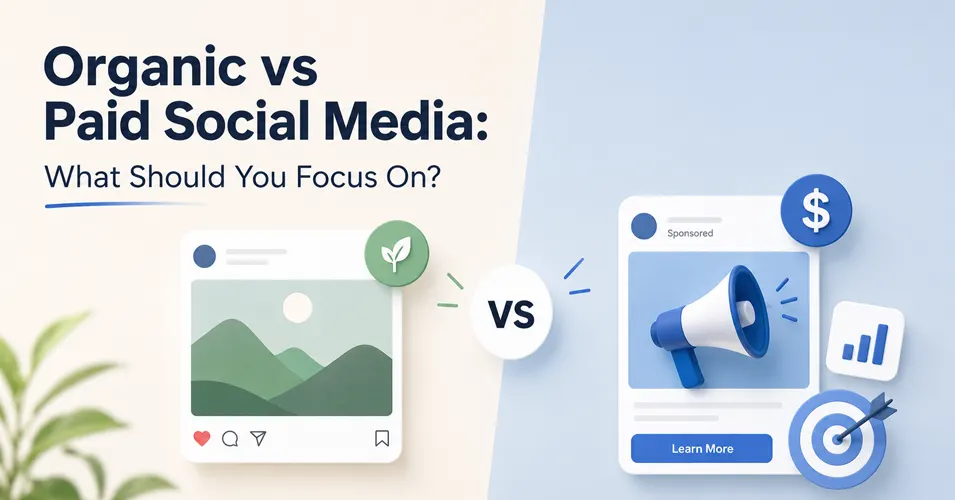
Why Businesses Get Stuck Between Organic and Paid Social
A business spends months posting content, trying different formats, staying active across platforms, and still sees growth slow down unexpectedly.
Reach becomes inconsistent. Engagement shifts without much pattern. Content that performed well a few months ago suddenly struggles to get noticed at all.
After a while, paid ads start looking like the obvious solution.
The visibility comes faster. Campaigns generate clicks almost immediately. Targeting feels more controlled compared to waiting for organic posts to spread naturally through the platform.
Then the other concern appears just as quickly: how long can the business keep paying to maintain that attention?
Organic content can build familiarity over time, but the growth is usually slower and harder to predict. Paid campaigns solve that problem quickly. Reach increases faster, targeting becomes more precise, and results appear sooner.
The trade-off changes once the campaigns stop running.
Some businesses are comfortable paying for faster visibility because speed matters at that stage. Others start questioning whether the attention is sustainable if every increase in reach depends on continued spending.
The situation looks different depending on the business itself.
A newer company entering a competitive market may need exposure immediately just to get noticed. A more established brand may care less about rapid reach and more about staying visible to existing audiences without constantly increasing advertising costs.
Eventually, the decision becomes more practical than philosophical. The real issue is usually figuring out what the business needs more urgently: stronger long-term familiarity or faster short-term reach.
Organic Social Media Builds Momentum Slowly
Organic growth rarely feels dramatic while it is happening.
Most businesses spend a long time posting before they notice any real momentum. The audience grows gradually. More people begin recognizing the brand name, returning to the page, or engaging with content repeatedly instead of discovering the business once and disappearing.
That familiarity is where a lot of organic value comes from.
A company sharing useful content consistently over time often becomes easier to trust because people keep seeing the business in relevant situations. Not every post performs well individually, but the repetition slowly builds recognition.
The challenge is that organic reach no longer behaves consistently across platforms.
A strong post may perform unexpectedly well one week, while similar content struggles the next time. Businesses often mistake this fluctuation for failure and start changing direction too quickly before the long-term effects of the content have time to build.
Posting more frequently does not always solve the problem either.
A business publishing every day without a clear message can become easier to ignore than a smaller company posting less often with stronger audience relevance and clearer positioning behind the content.
Organic social media growth usually works best when the content stays recognizable over time instead of constantly reacting to trends, formats, or algorithm changes.
A local business answering common customer questions regularly may never go viral, but the audience slowly begins associating that business with useful information and familiarity. Months later, when the service is finally needed, the business is already remembered.
Building audience organically creates that kind of long-term advantage. People become familiar with the brand before they are ready to buy, which often lowers resistance later when they eventually reach a decision point.
The process is slower, though.
Many businesses lose patience before a long-term social media strategy has enough time to compound properly.
Paid Social Media Prioritizes Speed and Targeting
Paid social media solves a problem organic content usually cannot solve quickly: immediate visibility.
A business can launch a campaign, define a target audience, and start reaching potential customers within hours instead of waiting months for organic momentum to build gradually.
That speed becomes useful in situations where timing matters.
A new business entering the market may need attention quickly. A company launching a product or promotion may not have time to rely entirely on long-term organic growth. Paid campaigns help shorten that gap by pushing visibility directly toward selected audiences instead of waiting for algorithms to distribute content naturally.
The targeting is usually the biggest advantage.
Organic content reaches whoever the platform decides to show it to. Paid campaigns allow businesses to narrow the audience intentionally through interests, behavior, demographics, location, or previous interactions with the brand.
That level of control changes customer acquisition significantly.
Businesses can test:
- Offers
- Messaging
- Audiences
- Creatives
- Landing pages
much faster than organic social media typically allows.
Paid social media for leads also produces clearer short-term feedback. Campaign performance becomes measurable quickly, making it easier to identify what is generating clicks, inquiries, or conversions.
The trade-off is sustainability.
Organic content can continue attracting attention after publishing. Paid traffic usually slows the moment spending stops. A campaign performing well today may disappear completely next week if the budget is removed.
That dependence creates pressure many businesses underestimate at the beginning. Especially when social media ads for conversions start working well enough that the business begins relying on paid reach continuously to maintain growth.
The Real Difference Is Sustainability vs dependency
The biggest difference between organic reach vs paid reach is not visibility alone. It is what happens after the attention arrives.
Organic social media tends to build familiarity gradually. People see the business repeatedly over time, recognize the messaging, and become more comfortable with the brand before taking action. The process is slower, but the connection often lasts longer because the audience relationship develops more naturally.
Paid reach works differently.
The visibility scales much faster, especially when campaigns are well targeted and supported by strong creative. A business can expand reach quickly, test multiple audiences, and increase traffic in a relatively short period of time.
That scalability becomes valuable when growth speed matters.
The risk starts when paid traffic becomes the only reliable source of attention. Some businesses reach a point where engagement, inquiries, and sales slow down almost immediately whenever campaigns pause. The marketing system keeps functioning, but only while spending continues.
Dependence on paid ads usually becomes expensive over time if the business is not strengthening audience familiarity alongside the campaigns themselves.
Organic-only strategies carry their own limitations too.
A business relying entirely on organic growth may struggle to expand beyond its existing reach, especially on platforms where visibility fluctuates constantly. Strong content still matters, but slower distribution can limit growth even when the messaging is solid.
Sustainable social media marketing usually comes from understanding what each approach contributes instead of expecting one method to solve every stage of growth independently.
That balance becomes easier to manage when the content supports long-term trust and follows a social media strategy that converts instead of chasing reach alone.
What Makes More Sense at Different Business Stages?
The right balance between organic and paid social media usually changes as the business grows.
An early-stage business often has a visibility problem first. Very few people know the brand exists, which makes customer acquisition slower regardless of how consistent the content may be. In that situation, paid campaigns can help shorten the gap by putting the business in front of relevant audiences faster than organic reach typically allows.
Speed matters more during that stage.
Waiting entirely on organic momentum can become difficult when the business still needs inquiries, traffic, or initial brand awareness to grow sustainably.
The priorities begin shifting once the audience becomes more established.
A company with recognizable branding, repeat customers, or steady engagement usually benefits more from strengthening retention and familiarity instead of relying only on paid reach. Organic content becomes more valuable there because the audience already understands the business and responds more easily to consistent messaging.
Budget limitations also influence the decision heavily.
A smaller business with limited resources may struggle to maintain aggressive ad spending for long periods. Another company with stronger margins may use paid social media for leads more comfortably because the acquisition costs remain sustainable within the business model.
Different goals create different pressures too.
A business focused on immediate lead generation may prioritize paid campaigns earlier. A company investing in long-term positioning may accept slower organic growth while building stronger audience trust gradually.
The balance rarely stays fixed.
Priorities change as visibility improves, budgets expand, and customer behavior becomes easier to understand over time.
Most Businesses Don’t Need to Choose One Exclusively
The discussion around organic social media vs paid ads often becomes too absolute.
Some businesses treat paid campaigns as a shortcut for weak content. Others avoid advertising completely and expect organic posting to handle every stage of growth on its own. Both approaches usually create limitations after a certain point.
Organic and paid social media solve different problems.
Organic content helps businesses stay familiar to existing audiences. It builds credibility gradually through repeated exposure, recognizable messaging, and ongoing interaction. A company posting useful, relevant content consistently often becomes easier to trust over time because the audience keeps seeing evidence of expertise and activity.
Paid amplification works differently.
Its strength comes from reach and precision. Campaigns can place the business in front of new audiences quickly, especially when customer acquisition speed matters more than long-term familiarity in the short term.
The stronger strategies usually connect both intentionally instead of separating them completely.
Paid campaigns may introduce people to the business for the first time. Organic content then helps reinforce credibility after the click, giving visitors more reasons to stay engaged beyond the advertisement itself.
Without that follow-through, paid traffic can become expensive very quickly.
A business may succeed in generating clicks while struggling to hold attention afterward. Poor engagement quality often starts there. The campaigns continue driving visibility, but the supporting content fails to build enough trust or interest to convert social media traffic consistently.
The imbalance works in both directions.
Strong organic content with no amplification can struggle to scale. Heavy ad spending without meaningful content underneath can create temporary spikes without lasting audience connection.
The Better Question Is Where Your Current Strategy Is Weakest
Most businesses are not struggling because they chose organic or paid social media incorrectly.
The bigger issue is usually imbalance.
One company invests heavily in paid campaigns while the content underneath does very little to build trust once people arrive. Another publishes consistently for months but never expands beyond the same limited audience because reach and targeting remain too narrow.
The weak point changes depending on the business itself.
Some companies need stronger content systems before increasing ad spend. Others already have solid messaging and audience engagement but need better amplification to reach new people consistently.
The more useful question becomes:
- where is growth slowing down?
- where are people losing interest?
- what part of the system is no longer supporting the next stage of growth?
Those answers usually make prioritization much clearer.
That’s often where experienced social media marketing services become valuable. Not simply for running campaigns or scheduling posts, but for helping businesses understand whether the current limitation comes from weak audience growth, inefficient ad spending, inconsistent messaging, or poor conversion movement.
Once those gaps become clearer, the decisions around organic and paid social media usually become easier to make as well.
Make the Smart Marketing Choice for Your Business
Contact us now and let's embark on the journey to online success together!