Why SEO Efforts Often Feel Disconnected
A page gets optimized. Keywords are added, headings are cleaned up, and technical fixes are completed. Still, rankings barely move.
Then the opposite happens somewhere else. A weaker page with average content continues outranking stronger pages simply because the site behind it carries more authority.
That disconnect creates a lot of confusion around SEO.
Some businesses focus heavily on content updates but ignore authority signals completely. Others spend months building backlinks while the actual pages remain thin, outdated, or poorly structured. In both cases, the SEO work exists, but the results feel inconsistent.
The frustration usually starts when effort no longer matches outcome. Traffic stays flat, visibility drops unexpectedly, or optimized pages never reach competitive positions despite following standard recommendations.
A lot of this confusion comes from treating SEO like separate tasks instead of connected signals. Search engines do not evaluate content, authority, technical performance, and relevance independently. Each part influences how the others are interpreted.
That’s why some websites struggle with low search visibility even after investing time into SEO. The issue is often less about missing one tactic and more about imbalance across the entire strategy.
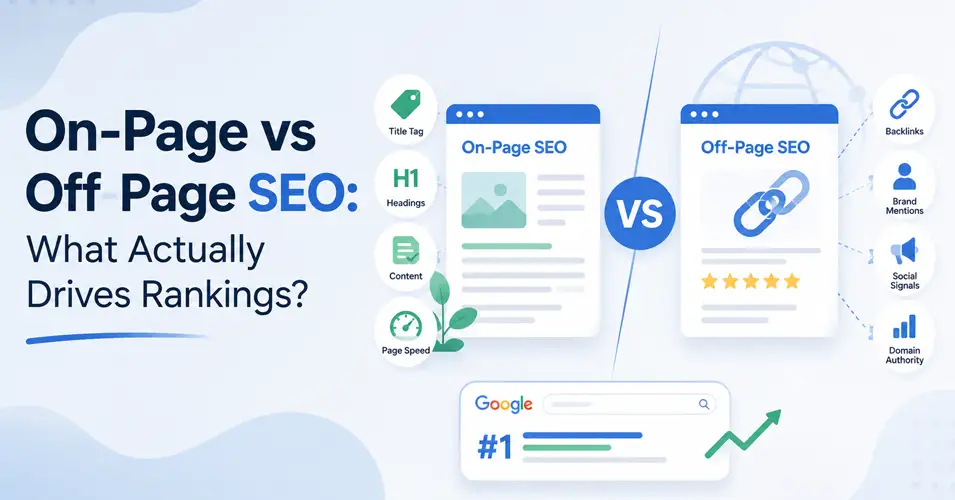
What On-Page and Off-Page SEO Actually Control
The difference between on-page vs off-page SEO becomes easier to understand once you stop treating them as competing strategies.
They influence different parts of the ranking process.
On-Page SEO:
On-page SEO focuses on the page itself. It helps search engines understand what the content is about, how relevant it is to the query, and whether the structure makes sense.
That includes things like:
- page titles
- headings
- internal linking
- content relevance
- keyword targeting
- page structure
A page with strong on-page SEO usually feels clear and focused. The topic matches the search intent, the information stays organized, and the page answers the query directly instead of circling around it.
Weak on-page optimization creates confusion quickly. A page may target several unrelated topics, repeat keywords unnaturally, or fail to explain the subject with enough depth.
Off-Page SEO:
Off-page SEO works differently. Instead of explaining the page, it influences how trustworthy or authoritative the website appears overall.
Backlinks are the most obvious example, but authority signals go beyond link quantity alone. Search engines also evaluate link quality, relevance, and the overall reputation surrounding the website.
That distinction matters because strong authority can help good content perform better, but it rarely rescues weak pages consistently.
The real difference between on-page and off-page SEO comes down to relevance versus trust. One helps search engines understand the content. The other helps them decide how much confidence to place in it.
Why Good Content Alone Often Isn’t Enough
A well-written page can still struggle to rank.
That usually surprises people after spending time improving content structure, adding keywords carefully, and covering the topic in depth. The page feels stronger than competing results, yet visibility barely changes.
In competitive search results, relevance alone rarely carries enough weight.
Search engines also look for signals that suggest the website itself can be trusted. Backlinks play a large role here because they act as external references pointing toward the content. When respected websites link naturally to a page, the page gains more credibility in search evaluation.
The absence of those signals becomes more noticeable in crowded industries. A newer website may publish genuinely useful content and still remain buried beneath older domains with stronger authority profiles.
Weak domain authority creates this situation often. The content may deserve visibility, but search engines have limited external signals confirming that trust.
This is also why copying high-ranking content structures rarely guarantees results. Two websites can target the same topic with similar formatting, while rankings still differ significantly because authority levels are completely different.
Content relevance still matters deeply. Backlinks cannot replace poor writing or weak information. But relying on content alone becomes difficult once competition increases and stronger domains enter the same search space.

Why Backlinks Alone Also Fail
Strong backlinks can push a page into visibility, but they cannot keep weak content performing for long.
A lot of websites run into this problem after investing heavily in authority-building. Rankings improve briefly, impressions increase, and then performance starts flattening again because the page itself does not give users enough reason to stay engaged.
Poor content quality usually becomes obvious after the click.
The page may contain the right keywords and attract links successfully, yet the information feels repetitive, shallow, or disconnected from the original query. Visitors land expecting answers and leave with partial explanations instead.
Search intent creates another major gap. A page targeting informational searches might lean too heavily into sales messaging. Another page may answer the topic broadly while the visitor was expecting something specific and actionable.
That mismatch affects visibility more than many websites realize.
A few common examples look like this:
- a guide article that spends most of the page promoting services
- a landing page trying to rank for informational searches
- thin articles targeting competitive keywords without meaningful depth
- pages optimized technically but offering little practical value
Many SEO performance issues begin here. The authority signals look strong from the outside, but the page experience weakens once users actually interact with the content.
Backlinks help search engines discover trust signals. They do not automatically explain whether the page solved the user’s problem well enough.
That’s also why websites trying to optimize website content for SEO need to think beyond keywords alone. Relevance improves when the page aligns with what the visitor actually expects to find, which becomes easier to understand when looking at how to create content that aligns with buyer intent.
What Actually Drives Rankings in Practice
The debate around on-page vs off-page SEO usually creates the wrong impression. Rankings are not decided by choosing one side over the other.
Search engines evaluate multiple signals together.
Content relevance helps explain what the page is about. Authority signals help validate whether the page deserves visibility compared to competing results. Technical SEO supports both by making the website easier to crawl, faster to load, and more stable across devices.
Once one area weakens, the others lose effectiveness as well.
A strong backlink profile cannot consistently carry thin pages. At the same time, excellent content often struggles in competitive spaces when the website lacks authority or trust signals.
Internal structure matters more than many sites realize too. Proper internal linking helps search engines understand relationships between pages and topics. It also distributes authority across the website instead of isolating important pages from the rest of the structure.
User behavior influences rankings indirectly as well. Slow loading pages, confusing layouts, or frustrating mobile experiences affect how people interact with the site after landing on it. Weak page experience signals rarely destroy rankings alone, but over time they weaken engagement and reduce overall performance.
A lot of discussions about ranking factors oversimplify how SEO works. Real ranking movement usually happens when relevance, authority, technical health, and usability start supporting each other instead of working independently.
That balance is much closer to what actually drives rankings in SEO than any single tactic on its own.
Which One Should You Focus On First?
The answer depends more on the current condition of the website than on SEO theory.
A newer website usually benefits from stronger on-page foundations first. Search engines need enough context to understand what the pages cover, how the content is structured, and which topics the site is actually trying to compete in.
Building backlinks too early often creates weak results when the content underneath is still underdeveloped.
For example:
- A service page with thin explanations rarely benefits much from aggressive link building
- A blog targeting competitive keywords without topical depth usually struggles regardless of authority
- A technically messy site can lose visibility even with decent backlinks pointing toward it
Content quality and structure normally deserve attention before scaling authority-building efforts.
The balance shifts in more competitive industries.
A website may already have strong content, clear structure, and proper optimization, yet rankings remain stuck because competing domains carry significantly stronger authority signals. At that stage, improving website authority becomes more important because relevance alone no longer creates enough separation.
SEO priorities also change over time.
Early-stage websites often need:
- Better structure
- Clearer topical focus
- Stronger internal linking
- More complete content coverage
More established websites usually focus on:
- Authority growth
- Trust signals
- Competitive positioning
- Strengthening visibility in crowded search results
That’s why the question “which is more important on-page or off-page SEO” rarely has one fixed answer. The stronger approach is identifying which side is currently limiting growth and addressing that gap first.
Most long-term ranking improvements happen when both areas mature together instead of being treated as separate strategies.
SEO Problems Usually Come From Imbalance, Not Absence
Many websites are not failing because SEO is completely missing. The bigger issue is usually imbalance.
One site invests heavily in backlinks while ignoring weak service pages. Another focuses only on content updates without improving authority or technical structure. Rankings start plateauing because one side of the strategy keeps outgrowing the other.
Search engines evaluate websites more holistically now. Relevance, authority, technical performance, and usability influence each other constantly. When one area falls behind, the overall SEO performance becomes harder to sustain.
That imbalance is not always obvious during a surface-level review. A website may appear technically healthy while struggling with weak topical relevance. Another may publish strong content but lose visibility because authority signals remain too limited for competitive searches.
A proper professional SEO analysis usually identifies those gaps faster because the focus shifts from isolated fixes to broader patterns affecting visibility.
If rankings continue feeling inconsistent despite ongoing optimization, reviewing the situation through experienced SEO services can help uncover whether the limitation comes from weak authority, content relevance, technical gaps, or a combination of overlapping issues.
In many cases, the missing piece is not more SEO activity. It’s better alignment between the parts already in place.
Make the Smart SEO Strategy for Your Business
Contact us now and let's embark on the journey to online success together!