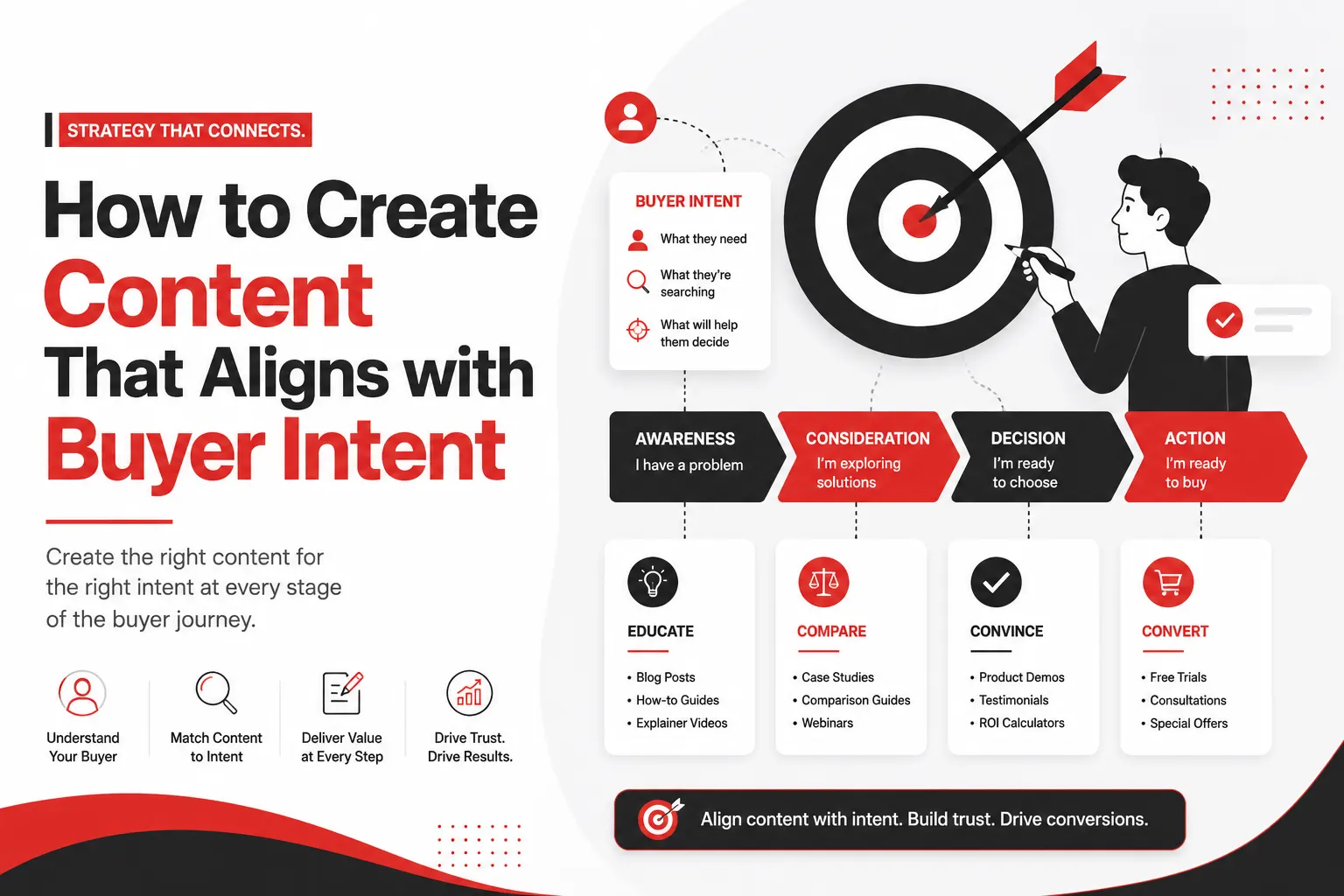
How to Create Content That Actually Converts — A Pakistan Business Guide to Buyer Intent
Most Pakistani businesses publish consistently and see little in return. The fix is not more content — it is content that matches what your buyer is trying to accomplish right now. This guide shows you how, with a real Karachi case study and PKR costing.
More Content Does Not Always Mean Better Results
Most Pakistani businesses that struggle with digital marketing are not struggling to publish. Blogs go out. Service pages exist. Social content moves on schedule. The output is there. WhatsApp broadcasts, Instagram reels, LinkedIn posts — the calendar stays full.
The problem shows up elsewhere. Traffic arrives on the website, but few inquiries follow. Certain pages rank in Google and still produce nothing. Blog posts attract readers who were never realistic customers. The numbers suggest activity, but the business impact is hard to point to — especially when every rupee of marketing budget is under scrutiny.
In Pakistan's digital market — particularly in Karachi's B2B services sector — paid acquisition costs (Google Ads, Meta) have risen 30–45% over the past two years as more businesses move online. Organic, intent-aligned content is now one of the most cost-effective channels available to SMEs with budgets between Rs. 20,000 and Rs. 100,000 per month.
When poor results persist, the usual response is to publish more. Cover more topics, target more keywords, increase frequency. The assumption is that volume is what is missing. It rarely is. Content fails commercially not because there is too little of it, but because it is attracting the wrong people at the wrong moment.
Buyer Intent Is Really About Expectations
Buyer intent is not a keyword classification system. Sorting searches into informational, commercial, and transactional buckets is a useful starting point, but it does not explain why content succeeds or fails with any real audience in Pakistan's market.
What intent actually describes is the expectation a person carries into a search. They are not just looking for information. They are trying to accomplish something specific at that moment, and the content they engage with is the content that aligns with that specific purpose.
The difference is immediate and concrete in Pakistan. Someone searching "ڈیجیٹل مارکیٹنگ کیا ہے" (what is digital marketing) is curious — weeks or months away from buying anything. Someone searching "best digital marketing agency Karachi with pricing" is evaluating options today. Someone searching "Boundless Technologies reviews" is one conversation away from a decision. These three queries share semantic territory; the expectation behind each is entirely different.
The Three Stages of Buyer Intent — Pakistan Search Examples
The Same Topic Attracts Completely Different Audiences
Keywords do not tell the full story about the audience a piece of content brings in. Two articles targeting closely related phrases can attract visitors at entirely different stages of their decision process, and produce entirely different commercial outcomes.
Consider a web agency in Karachi writing about website design. An article titled "Why good website design matters for Pakistani businesses" attracts curious readers who are months away from commissioning anything. An article titled "How much does a website cost in Pakistan (2025 PKR pricing)" attracts someone actively budgeting. A page titled "Website development packages Karachi — from Rs. 35,000" attracts someone ready to make a call today.
The underlying topic is the same. The audience, the expectation, and the likelihood of conversion differ enormously across the three. Most Pakistani business websites have the first type of content in abundance and the third type barely present.
High-Intent vs. Low-Intent Keyword Patterns for Pakistan
🔴 Low Intent (Awareness)
- what is SEO in Urdu
- digital marketing basics
- how to make website
- social media tips Pakistan
- content marketing explained
🟡 Mid Intent (Evaluation)
- SEO agency Karachi pricing
- content writing rates Pakistan PKR
- best digital agency Lahore
- WordPress vs Shopify Pakistan
- Google Ads cost Pakistan
🟢 High Intent (Decision)
- hire SEO expert Karachi
- website development quote Pakistan
- Boundless Technologies contact
- monthly SEO package PKR
- free website audit Karachi
Intent Mismatch — Why Pakistani Content Often Fails
Most content performance problems in Pakistan trace back to a gap between what the visitor was trying to accomplish and what the content actually delivered. This mismatch is not always obvious from analytics. The page may rank. The traffic may exist. Everything appears to be working.
What the metrics do not surface is the friction. A visitor arrives with a specific expectation. The content addresses a related topic but not quite the one they needed at that moment. They read briefly, find nothing that directly helps them, and leave. The bounce rate rises, time on page stays low, and WhatsApp or phone inquiries remain weak. Those are symptoms of a content experience problem, not a traffic problem.
Intent mismatch in Pakistan happens most often in two situations: when content targets a keyword without accounting for what someone searching it is actually trying to do; and when content targets the right topic but at the wrong decision stage. A blog post that thoroughly educates someone who already knows the basics and now needs a quote produces exactly the same result as irrelevant content — the visitor leaves without acting.
Pages that receive traffic without producing conversions are worth reviewing for intent alignment before adjusting technical elements. An SEO audit can reveal which pages draw visitors whose expectations the content is not meeting — frequently a more productive starting point than optimising pages that were never aimed at the right audience.
Case Study: Karachi E-Commerce Brand — Cutting CAC by 56% with Intent-Aligned Content
From Rs. 4,200 CAC to Rs. 1,850 CAC in 6 Months
How a Karachi-based home furnishings e-commerce brand aligned its content with buyer intent and dramatically reduced its Customer Acquisition Cost — without increasing total marketing spend.
What Was Done — 6-Month Timeline
Mapped existing 34 blog posts against buyer intent stages. Found 29 of 34 were awareness-only. Identified 18 high-intent keyword gaps (evaluation + decision stage) specific to Karachi home furnishing buyers. Cost: Rs. 18,000 (audit + keyword research).
Published 12 new articles targeting mid and decision-stage keywords: "best sofa brands in Pakistan under Rs. 50,000," "where to buy furniture online Karachi," "local vs. imported furniture comparison PKR." Also created 3 PKR pricing guide pages. Cost: Rs. 36,000 (content writing + on-page SEO).
Added FAQ schema to all new content for AI engine visibility (ChatGPT, Gemini, Perplexity). Optimised page speed (LCP improved from 4.2s to 2.1s on mobile). Added local business schema with Karachi coordinates. Cost: Rs. 22,000 (technical implementation).
Added intent-matched CTAs to each content piece. Reduced Meta Ads spend by 30% (Rs. 45,000 → Rs. 31,500/month) as organic started converting. Tracked WhatsApp inquiries from organic sources. Cost: Rs. 14,000 (CRO + tracking setup).
Total Investment Breakdown (PKR)
| Activity | Month(s) | Cost (PKR) | Who |
|---|---|---|---|
| Intent audit & keyword research | 1 | Rs. 18,000 | Agency |
| 12 articles (mid + decision intent) | 2–3 | Rs. 36,000 | Agency |
| 3 PKR pricing / comparison pages | 2–3 | Rs. 12,000 | Agency |
| Technical SEO + schema + AEO setup | 4 | Rs. 22,000 | Agency |
| CRO + WhatsApp tracking setup | 5–6 | Rs. 14,000 | Agency |
| Meta Ads (reduced from month 5) | 1–6 | Rs. 2,22,000 | In-house |
| TOTAL 6-Month Investment | Rs. 3,24,000 | ||
CAC Before vs. After
CAC Payback: 9.4 months
CAC Payback: 4.1 months
AEO & GEO: Getting Found by AI Engines in Pakistan
Answer Engine Optimisation (AEO) and Generative Engine Optimisation (GEO) are the newest layers of search visibility. When a Pakistani business owner asks ChatGPT, Gemini, or Perplexity "best SEO agency in Karachi," the answer comes from web content — and it favours pages that are structured, specific, and locally relevant.
For Pakistan, this means three things: including city-level signals (Karachi, Lahore, Islamabad, DHA, Gulshan), using PKR pricing (AI engines surface concrete figures), and formatting content with direct question-and-answer structures that AI models can lift verbatim.
What AI Engines Should Answer for Your Brand
AEO / GEOMonthly SEO packages in Pakistan range from Rs. 15,000 for basic local SEO to Rs. 80,000–Rs. 1,50,000 for full-service campaigns targeting national or competitive keywords. Most Karachi-based agencies offer tiered packages; expect 4–6 months before meaningful organic traffic growth.
Buyer intent describes the specific goal a person is trying to accomplish at a given moment — not just their search keyword. Content that matches buyer intent converts because it speaks to what the visitor actually needs at their current stage: awareness, evaluation, or decision.
By replacing or supplementing paid ads with intent-aligned organic content, Pakistani businesses can reduce CAC by 40–60%. A Rs. 90,000 content investment over 3 months can deliver compounding returns that paid campaigns at the same spend cannot match after month 6.
Pakistan-Specific SEO Signals That Matter
Pakistani search behaviour has distinct patterns that generic content strategy frameworks miss. Mobile-first usage is near-universal — over 78% of Pakistani web traffic is mobile. Search queries frequently mix Urdu and English (Romanised Urdu is common). And local city-level targeting matters enormously: a Lahori buyer searching for services is unlikely to engage with content written entirely around Karachi examples.
Creating Better Content Starts Before the Writing Begins
Most content problems that surface during or after publication were created earlier — during planning. The topic looked right because the search volume was there. The format defaulted to whatever had been used before. Nobody stopped to ask what the reader was supposed to do differently after reading it.
Before writing begins, the most valuable question is not "what should this article say" but "what is this specific person trying to figure out, and what would genuinely move them forward?" That question changes the structure of the content, the depth it pursues, the examples it uses, and how it ends.
Pakistani search behaviour provides unusually clear signals. Searches framed as questions (usually in Romanised Urdu or mixed language) reflect early awareness. Searches that include "price," "cost," "rates," or "charges" reflect evaluation. Searches that include city names, brand names, or "contact" signal decision-stage intent. Reading those patterns before planning content is significantly more useful than analysing them after a piece has underperformed.
The decision about content format is part of this planning. Understanding whether a blog or a landing page better fits the intent behind a topic is one of the most practical decisions that shapes performance before the first sentence is written.
Your Content Alignment Checklist — Pakistan Edition
Before Publishing Any Piece of Content
- Does this content match the intent stage of the person most likely to find it? (Awareness / Evaluation / Decision)
- Does it include at least one Pakistan-specific signal? (City name, PKR pricing, local example, Pakistani market context)
- Is there a direct, answerable FAQ section that AI engines can index? (AEO)
- Does the CTA match the intent stage — not pushing a "contact us" on an awareness piece?
- Is the page mobile-optimised? (78%+ of Pakistani traffic is mobile)
- Does it include structured data (FAQ schema, local business schema, breadcrumb schema)?
- Have you included Urdu or Romanised Urdu variations of key terms where relevant?
- Is there a clear next step for the reader, matched to where they are in their journey?
Content Performs Better When It Solves the Right Problem
Businesses that consistently produce content without commercial results in Pakistan are usually solving the wrong problem. They improve volume, consistency, or production quality while the underlying mismatch — between what they publish and what their audience actually needs at that moment — stays unaddressed.
Fixing that mismatch does not always require more content. It sometimes requires stepping back to look at existing content with different questions. Which pages attract visitors who were never going to convert? Which topics pull in traffic from the wrong decision stage? Where are readers landing with a specific expectation and leaving because the content does not meet it?
For Pakistani businesses that have been producing content consistently without seeing the commercial results the investment should generate, the problem is rarely the writing itself. It is almost always the alignment between what was written and what the audience was actually looking for. Experienced content writing services can help identify where that alignment has broken down and what kinds of content would better serve Pakistani buyers at each stage of their decision process.
Frequently Asked Questions
Pakistan Content Marketing — Common Questions
FAQFor B2B digital services in Pakistan, a CAC below Rs. 2,000–3,500 is considered healthy when content is the primary channel. Paid-only strategies typically result in CAC of Rs. 4,000–8,000+ in competitive verticals. The case study above achieved Rs. 1,850 after 6 months of intent-aligned content.
Most Pakistani businesses see measurable organic traffic increases within 3–5 months. Conversion improvements and CAC reduction typically become visible by month 4–6, with compounding returns through month 12 and beyond as domain authority builds.
GEO means structuring your content so AI tools like ChatGPT, Gemini, and Perplexity cite it when answering questions. For Pakistan, this requires city-specific signals (Karachi, Lahore, Islamabad), PKR pricing, and FAQ-structured content with direct answers. Businesses that optimise for GEO now gain an early-mover advantage in AI search.
A realistic starting budget is Rs. 25,000–50,000 per month for a mix of 4–6 intent-targeted articles plus basic SEO. Results compound over time, so the cost per acquired customer drops significantly after month 6. The case study above averaged Rs. 54,000/month in content investment and achieved a 56% CAC reduction.